Team
Charles Meng, Rishab Bajaj, Eva Devanathan, Prithvi Rey
Role
Project Manager, UX Designer
Duration
3/2025 to 12/2025
Tools
A lot

Background
Timeline
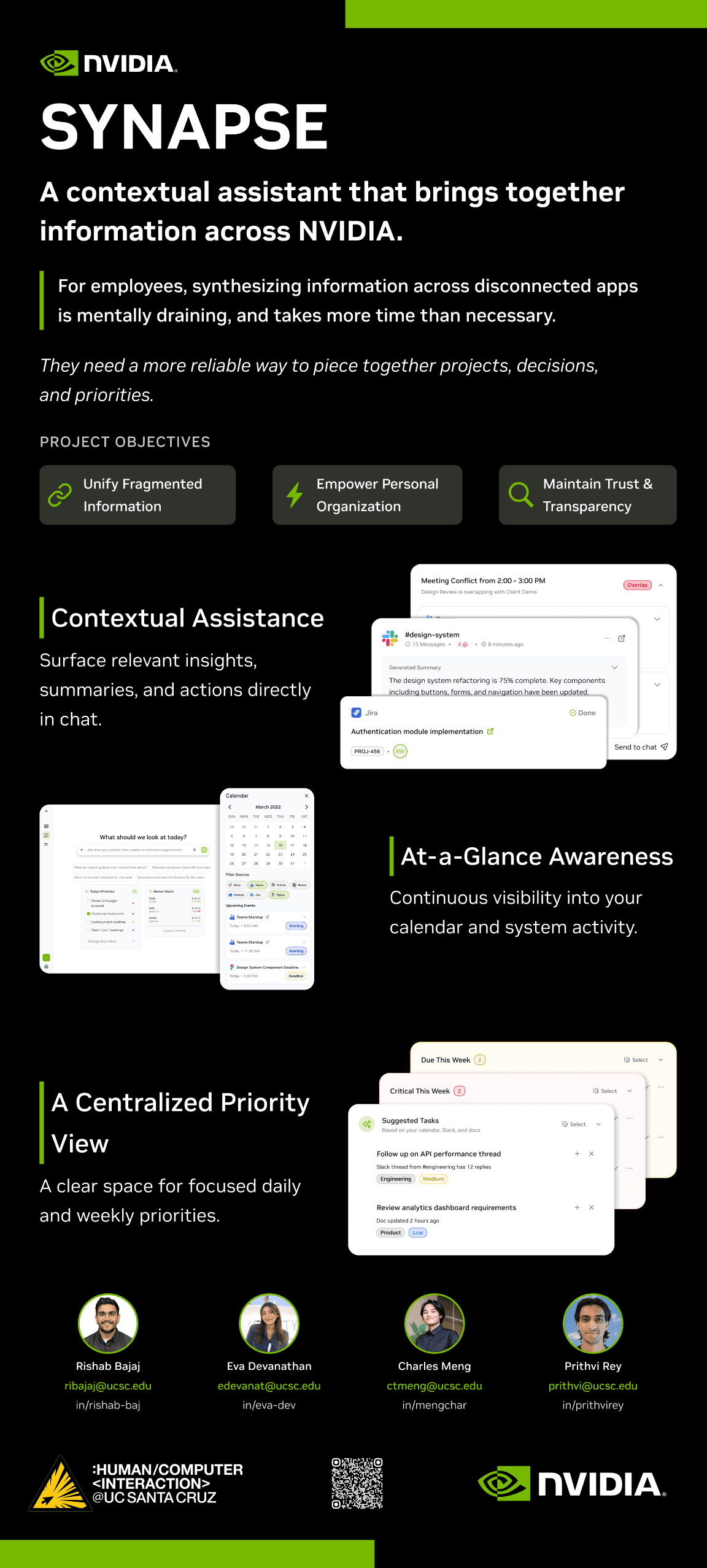
From Spring to Fall, we spoke with real NVIDIA employees, consulted mentors, advisors, and colleagues, designed a solution from 0 - 1, created a poster and a video, and finally presented everything to our cohort and other industry professionals.
Spring
Project Manager
Defined project scope, goals, deliverables, tasks, and timelines
Served as the main point of contact
Tracked project progress, monitored performance, managed changes
Fall
UX Designer
Created user flows, low & high fidelity wireframes, and interactive prototypes
Performed usability testing, gathered feedback, and iterated designs
Designed project poster and created sizzle reel
The average employee spends 2.5 hours a day searching for information.
(That’s 30% of their workday!)
Imagine taking an entire workday each week just to find things. That’s the reality we heard from NVIDIA employees. Taking this much time to build context is what overwhelms employees.
The Context Burden
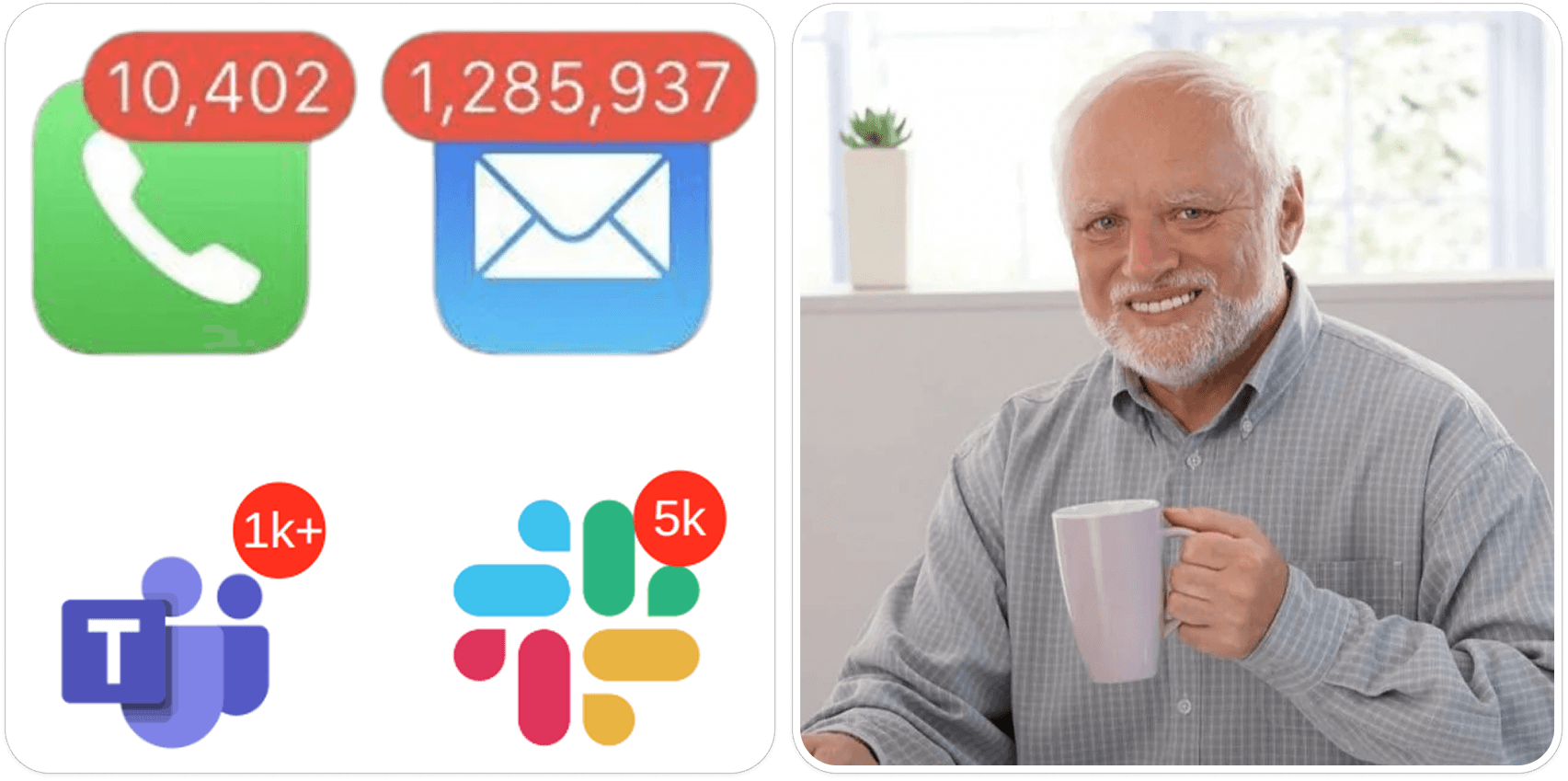
Employees often search for context, fragments, and details buried in threads, documents, or endless folders.
This leads to what we call the Context Burden. It causes mental fatigue, constant verification, and fragmentation across tools.
TLDR
Mental Fatigue
Constant Verification
Fragmented Tools

Achieving Clarity
Our Goal
Design a system that eliminates the frustration of dead-end searches.
Unify Information
Minimize Context Switching
Reduce Cognitive Load
Research
KPIs and Research Questions
Before brainstorming research questions, we first agreed on these KPIs to track and measure the business impact of our solution as we navigated through the project. RQs were based around these KPIs.
Reduce Information Overload

Workflow Lifecycle Reduction

Employee Satisfaction
Methods
We established an understanding of user needs and market context through four complementary methods.
Literature Review
30+ References
Referencing previous research for challenges in the enterprise environment, and supporting our findings.
Competitive Analysis
15 Competitors
Examine how others are solving problems in this space and uncover potential opportunities.
Semi-structured Interviews
9 Employees
Employee roles ranged from Managers to Data Scientists and Software Engineers.
Usability Sessions
3 Tests
Through tasked-based scenarios, and think-aloud protocols, we evaluated how effective our solution supports daily workflows.
Data Analysis
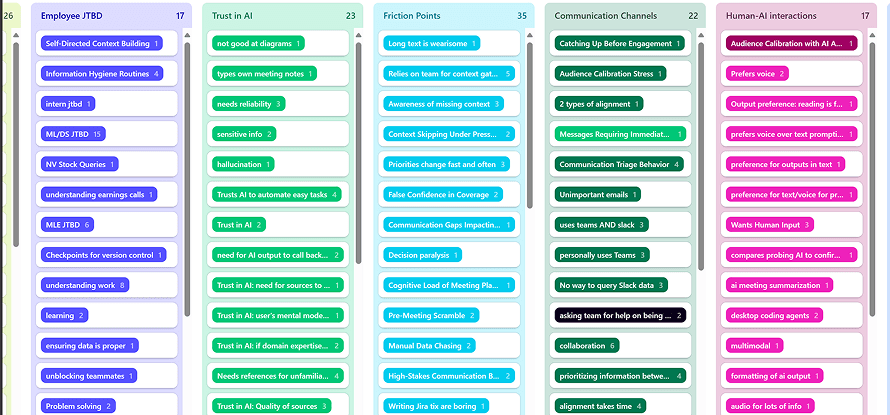
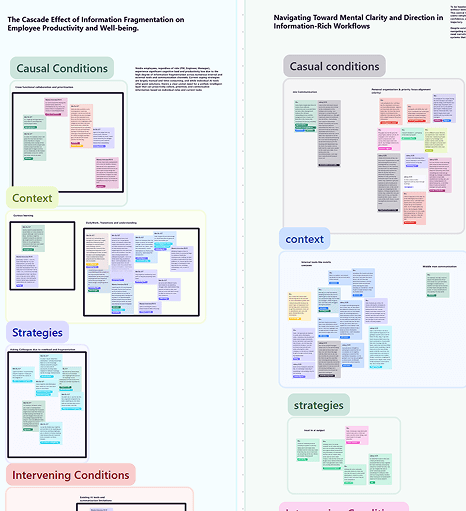
We compiled and open coded our research, clubbed the open codes into prominent categories, and formed relationships and links to bring together insights through stories.
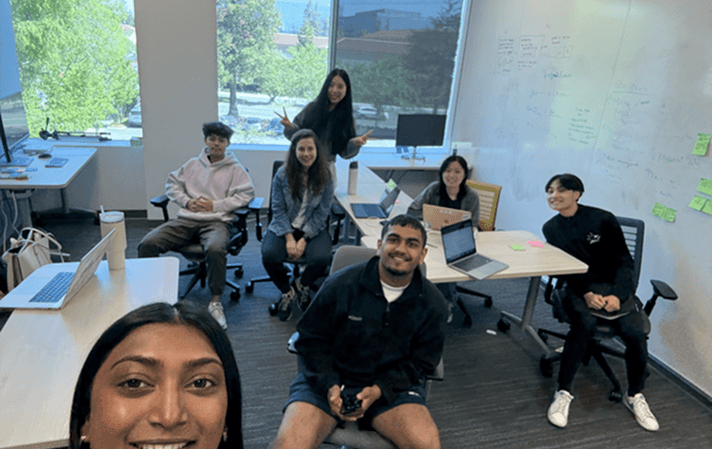
Shoutout to Eva for the picture!

Peer Engagement
We also asked our colleagues for some help as well. After looking at our data for so long, a fresh perspective was needed.
Let’s go over the main themes and insights that emerged from this analysis.
Insights
How fragmented information affects personal organization and deepens the need for stakeholder alignment
Breaking that down, the key themes we found were:
01
Fragmented Information
Employees must build context and alignment on their own, often leading to cognitive overload from constant information seeking.
Information Seeking
Prioritization
Cognitive Overload
02
Personal Organization
To manage fragmented tools, employees rely on personal organization routines to stay aligned and reduce mental load.
Mental Clarity & Direction
Actionable Info & Communication
Every Employee is Different
03
Alignment with Stakeholders
Alignment is then, a fundamental responsibility across roles. It’s how employees make sense of the information streams, but what they learn can change overnight.